
Pests and disease
Dying Pine Trees in Tyrone, GA
Bottom line
A pine in Tyrone, GA whose needles are fading from green to yellow to red, with small blobs of resin or fine sawdust on the bark, is most likely under attack by bark beetles: the southern pine beetle or one of the Ips engraver beetles. The Georgia Forestry Commission says chemical treatments cannot save a tree once it shows symptoms, and advises removing infested and storm-damaged trees quickly (Georgia Forestry Commission, checked Nov 22, 2026).
Ash trees face a separate killer: emerald ash borer has been confirmed in Fayette County (Georgia Forestry Commission, updated Sept. 26, 2023, checked Nov 22, 2026).
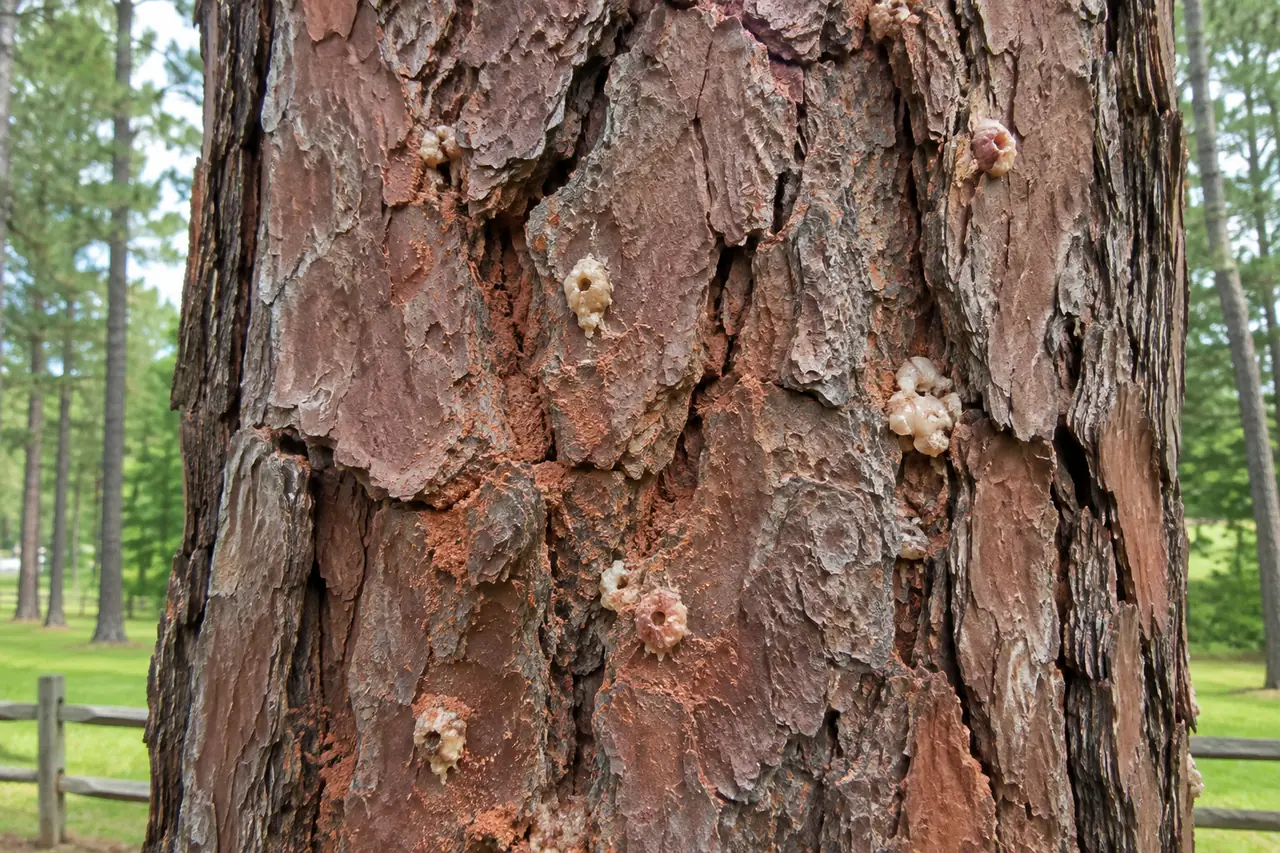
How do I know it's southern pine beetle?
The southern pine beetle is "not much bigger than an eye gnat," and it kills by carving winding, S-shaped egg galleries under the bark. From the outside, the signs are pitch tubes (resin oozing from entry holes) and boring dust, called frass. Needles turn from pale green to yellow to red, then brown. Drought-stressed trees may not make pitch tubes at all, so the other signs matter (Georgia Forestry Commission, southern pine beetles, updated May 26, 2026, checked Nov 22, 2026).
The Forestry Commission puts the beetle's toll in Georgia at more than $254 million worth of pine since 1972, and says Piedmont populations reach epidemic levels every six to 10 years, with outbreaks lasting one to three years. Loblolly, shortleaf and Virginia pine are the most susceptible; longleaf is more resistant. Its control advice for stands is to cut infested trees plus a buffer of uninfested trees around the leading edge, and it doesn't generally recommend insecticides to stop an infestation (GFC, checked Nov 22, 2026).
What are Ips engraver beetles?
Ips beetles are secondary pests that typically go after stressed, injured or weakened pines, which makes them the usual suspects after a drought, a lightning strike or a storm. Broken limbs, wounds and logging slash give them places to breed. The Forestry Commission lists four species in Georgia: the six-spined Ips, the eastern five-spined Ips, the small southern pine engraver and the pine engraver (GFC, Ips beetles and storm damage, checked Nov 22, 2026).
Signs to look for:
- "flagging," branches whose needles have faded or died;
- a crown yellowing, then going red and brown;
- small round exit holes, about 1/16 inch;
- fine sawdust at the base of the tree or on the bark;
- under loose bark, galleries shaped like an I, H or Y.
A UGA Extension entomologist described pitch tubes as the first and most often overlooked symptom, and yellowing needles, the thing most people notice first, as a sign it is often too late to save the tree. His advice was to have the beetle identified by a county Extension agent or a Forestry Commission forester and to remove infested trees quickly so the emerging adults don't move on to the next pine (UGA CAES, "Bark Beetles Attacking Georgia Pines," Sept. 30, 1998).
Why remove a beetle-killed pine soon?
- The beetles spread. Taking out infested trees removes the adults that would attack the next pine, per both UGA and the Forestry Commission.
- Dead pines fail. Coweta-Fayette EMC says its leading cause of outages is dead or dying trees, weakened by storms, pine beetles or drought, standing outside its cleared right-of-way (Coweta-Fayette EMC Powerlines, March 2025, checked Nov 22, 2026). A dead pine within reach of a roof is the same risk to a house.
- Storms feed the cycle. The Forestry Commission's storm guidance is to promptly remove or salvage storm-damaged trees because their wounds draw Ips beetles.
Is emerald ash borer in Fayette County?
Yes. The Georgia Forestry Commission's county list, as of Sept. 22, 2023, includes Fayette, along with Fulton, Clayton and Spalding next door. The beetle was first found in Georgia in July 2013, in DeKalb and Fulton counties (GFC, emerald ash borer, checked Nov 22, 2026). If an ash stands near the house, it is worth having it looked at.
What about oaks that are losing bark?
UGA Extension's guide to oak diseases describes hypoxylon canker as an opportunist that attacks trees weakened by heat, drought and other stresses. Yellowing and wilting are often the first sign; then bark sloughs off as fungal mats form underneath. The oaks most commonly infected are black, blackjack, laurel, live, post and white oaks, and the guide says to "remove infected limbs or trees once they become hazardous to property or people" (UGA Extension Bulletin 1286, checked Nov 22, 2026).
The same bulletin covers two root diseases worth knowing on clay soils:
- Phytophthora root rot: "rapid death of trees usually occurs following excessively wet periods," and infected trees may collapse and die quickly after leafing out in spring.
- Armillaria root rot: when infected trees are weakened, it "spreads rapidly through the roots."
Oaks in the red and black group are also the ones most often infected by heart rot, which shows as branch dieback and general decline. Bacterial leaf scorch looks like drought stress, with leaf edges browning, but comes back every year and moves to other parts of the tree (UGA Bulletin 1286).
Who identifies the problem?
For a diagnosis, the UGA Extension office for Fayette County and the Georgia Forestry Commission are the public sources. In Tyrone, the town's tree ordinance exempts removing a "dead, diseased, structurally unsound or infested" tree that is a danger to life or property, as determined by the county extension service, the state forestry commission, an arborist, a forester or the town manager (Tyrone Code Sec. 105-123(a)(2), checked Nov 22, 2026). For taking a dead or dangerous tree down, call (678) 788-6889 or send the request form; one independent local contractor looks at the tree and prices the removal. The tree removal page covers how a dead pine comes down beside a house.
Pest questions from Tyrone
One pine died. Will the ones next to it?
Not always. Ips often kill only weakened trees and sometimes their neighbors; southern pine beetle spots can grow. Watch the nearby pines for pitch tubes and fading needles.
Can a spray save a pine that's already turning red?
No. The Forestry Commission says chemical treatments can't save a tree once it shows symptoms.
Should I leave a dead pine for wildlife?
Far from the house, the street and the lines, maybe. Within reach of any of them, a dead pine is a hazard.