
Ground and trees
Tyrone, GA Yard Trees on Red Clay
Bottom line
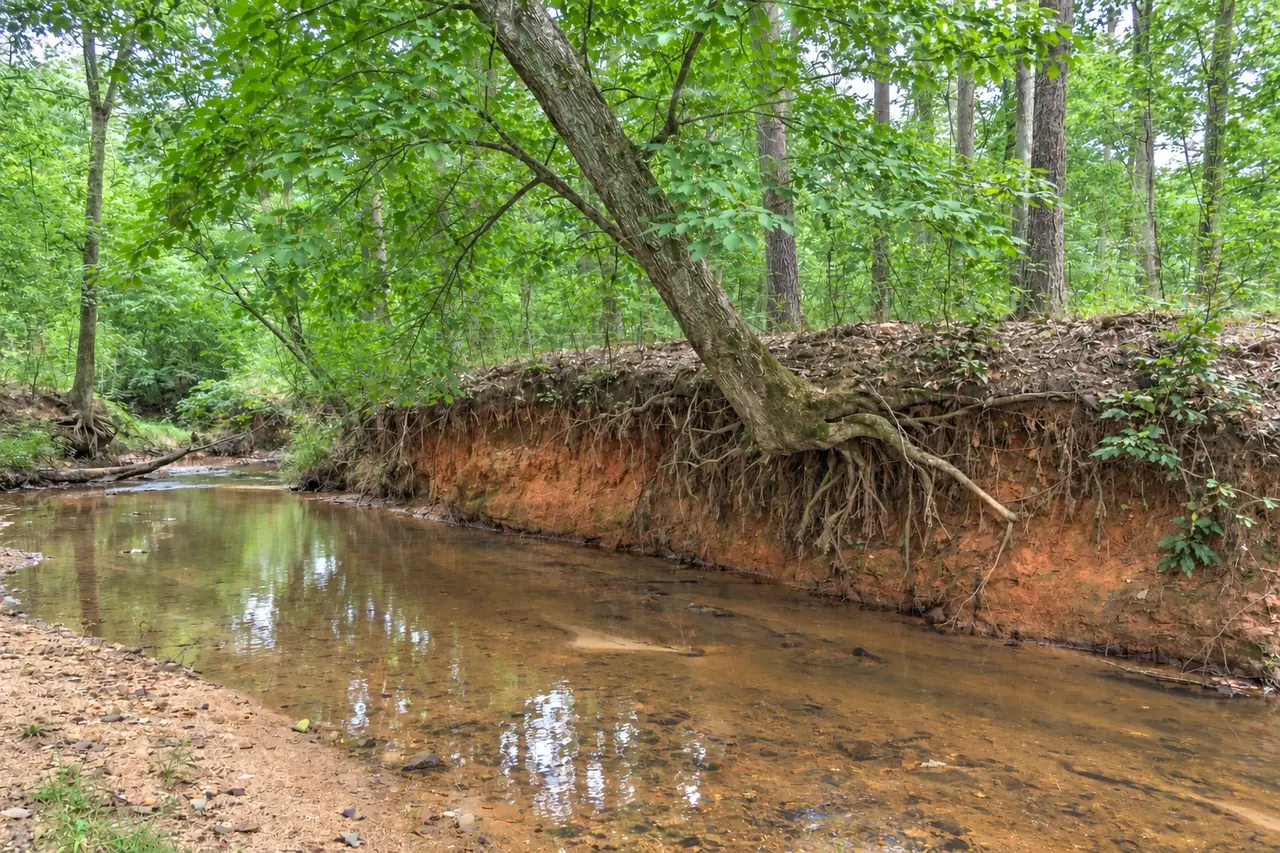
The trees in Tyrone, GA yards grow in Piedmont ground: a thin, sandy or loamy topsoil over red or reddish-brown clay that formed in place from weathered crystalline rock, with softer, wetter soil in the creek bottoms. On that ground, the USDA's description of the Cecil soil, a typical Piedmont upland series, gives its wooded areas as loblolly and Virginia pine, three oaks (red, white and post), hickory, blackgum, maple and dogwood (USDA NRCS, Cecil series, revised Nov. 2025, checked Nov 22, 2026).
Knowing the tree and the ground under it explains a lot about how it breaks, how it falls and what it takes to remove.
What is the ground like under Tyrone?
Fayette County calls itself part of Georgia's Piedmont region, with rolling hills, elevations from 720 to 1,005 feet and about 48.61 inches of rain a year (Fayette County, checked Nov 22, 2026). A 2020 geotechnical report for a county bridge where Darren Drive crosses Shoal Creek, near Fayetteville, describes the soils the way they run through much of the county:
- the bridge site lies in the Southern Piedmont Geologic Province, where "soils in this area have been formed by the in-place weathering of the underlying crystalline rock";
- near the surface, the leftover soil is typically red-brown clayey silt or silty clay, with sandy micaceous silt deeper down;
- stream valleys "may contain alluvial (water-deposited) soils"; at the creek, the borings found soft to firm brown sandy clay;
- partly weathered rock showed up about 17 to 23 feet down, and groundwater about 8 to 12 feet down, near creek level.
Source: Report of Subsurface Exploration, Darren Drive over Shoal Creek, Fayette County, Nov. 25, 2020.
Which soils does the USDA describe for Piedmont uplands?
The USDA's official soil series descriptions for three common Piedmont upland soils show why the clay matters to a tree. NRCS's Web Soil Survey maps which one sits under a particular lot.
| Series | Clay subsoil | Where it sits | Woods on it |
|---|---|---|---|
| Cecil | Red clay; very deep, well drained | Piedmont uplands, 0 to 25% slopes | Loblolly and Virginia pine, red, white and post oak, hickory, blackgum, maple, dogwood |
| Pacolet | Red clay, sandy clay or clay loam, ending 18 to 30 inches down | Gently sloping to very steep uplands, commonly 15 to 25% | Pine and mixed hardwoods |
| Appling | Strong brown clay under a brown sandy loam | Broad, nearly level to gently sloping ridges | Mixed hardwoods and pine |
Sources: USDA NRCS official series descriptions (Cecil revised Nov. 2025; Pacolet Aug. 2008; Appling Dec. 2005), checked Nov 22, 2026.
Which trees grow in Tyrone yards, and what goes wrong with them?
- Loblolly pine. The big pine of the Piedmont, and one of the three the Georgia Forestry Commission lists as most susceptible to southern pine beetle, with shortleaf and Virginia pine (GFC, checked Nov 22, 2026). See the dying pines page.
- Virginia pine. Also on the Forestry Commission's most-susceptible list, and on the Cecil soil's woods list.
- White and post oak. Both are on UGA Extension's list of the oaks most commonly hit by hypoxylon canker, which moves in after heat and drought (UGA Bulletin 1286, checked Nov 22, 2026).
- Red oaks. UGA says oaks in the red and black group are the ones most often infected by heart rot, which shows as branch dieback and general decline (Bulletin 1286).
- Ash. Not on the Cecil list, but where it grows here it faces emerald ash borer, confirmed in Fayette County (GFC, checked Nov 22, 2026).
- Hickory, blackgum, maple and dogwood. The rest of the Cecil soil's woods list. In Peachtree City, a tree's size class decides whether its removal needs a permit: 8 inches across for understory trees, 18 for canopy trees (Peachtree City, checked Nov 22, 2026).
How does clay change the way trees fall and come out?
- Wet spells. UGA Extension says that with Phytophthora root rot, "rapid death of trees usually occurs following excessively wet periods" (UGA Bulletin 1286, checked Nov 22, 2026). A long wet stretch is when to watch for a tree that suddenly wilts.
- Root plates. When a big tree blows over in clay, it tends to lift a wide plate of roots and soil and leave a matching hole, which has to be dealt with along with the trunk. See the emergency page.
- Grinding. A stump grinder throws a mix of wood chips and red clay, and wet clay makes the work and the cleanup slower. See the stump grinding page.
- Ruts. Wet clay lawns don't hold heavy trucks, which is why some removals are done with the trucks parked on the driveway.
What are Tyrone lots like?
Big and wooded. Tyrone's R-12, R-18 and R-20 home districts each require at least one acre, the conservation residential districts two or three acres, and agricultural-residential three acres (Tyrone Zoning Ordinance, Secs. 113-116 to 113-121, checked Nov 22, 2026). The town's 2006 community assessment counted streams, wetlands, floodplains and steep slopes among its critical natural resources and said Tyrone "no longer produces any crops or timber" (Town of Tyrone Community Assessment, 2006).
About 7,896 people lived in Tyrone in the latest Census Bureau figures summarized by Data USA, with 88.8% of homes owner-occupied and a median home value of $470,400 (Data USA, 2024 figures, checked Nov 22, 2026).
The town's homeowner guide adds two ground-level cautions for anyone building near trees: on sloped property, a silt fence may be required for erosion control, and stream buffers typically reach at least 25 feet from the water's edge (Town of Tyrone Homeowner's Guide, checked Nov 22, 2026).
Yard tree questions from Tyrone
How do I find out which soil is under my lot?
The USDA's Web Soil Survey maps soils across the county, down to the scale of a single lot. The official series descriptions linked above explain what each one is like a few feet down.
Who can tell me what's wrong with a tree?
The UGA Extension office for Fayette County and the Georgia Forestry Commission are the public sources for identifying pests and diseases. For a tree that needs to come down, the contractor looks at it in person.
Does red clay make trees fall more easily?
No public source gives a Fayette County figure. What the sources do show is that wet periods bring on root rot in oaks, and that the storms on record here have uprooted and snapped trees across the county.
To have a tree looked at, call (678) 788-6889 or send the request form. One independent local contractor sees the tree and the ground around it before giving a price.