
Utility lines
Trees and Power Lines in Tyrone, GA
Bottom line
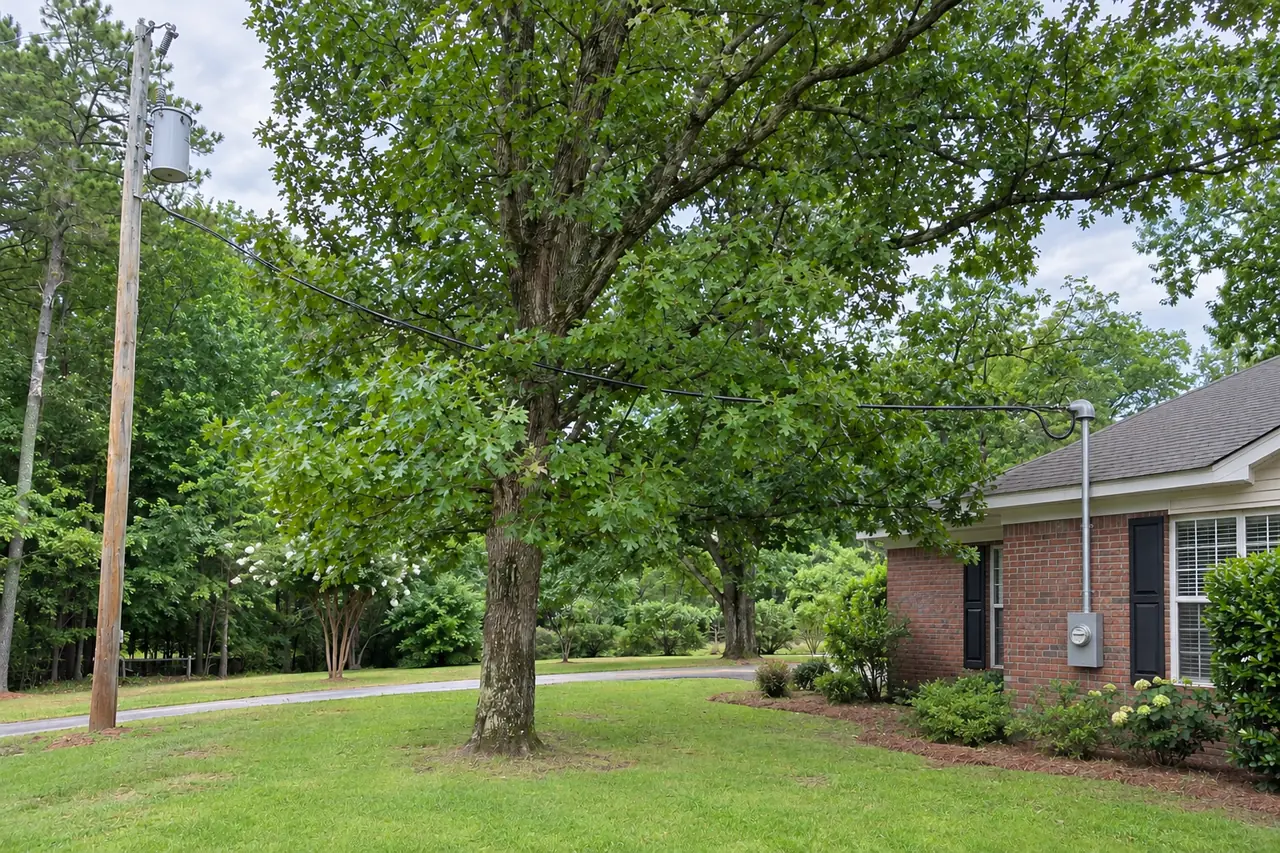
Around Tyrone, GA, the power lines along the road belong to Georgia Power or Coweta-Fayette EMC, depending on the street, and each utility clears its own lines; the limbs around the service wire running to your house are mostly the owner's to deal with. Georgia Power prunes around service wires only in limited cases and leaves tree removals and limbs over 3 inches thick to the property owner (Georgia Power, checked Nov 22, 2026).
To have Georgia Power disconnect the service wire for tree work, call 1-888-660-5890 at least 72 hours ahead. Coweta-Fayette EMC members call the co-op at 770-502-0226.
Which utility serves my street in Tyrone?
Fayette County says "there are two power companies serving Fayette County: Georgia Power Company and Coweta-Fayette EMC" (Fayette County, checked Nov 22, 2026). Neither the county nor the town publishes a street-by-street map, so the quickest check is the name on your power bill or the tag on the pole. Coweta-Fayette EMC is a member-owned co-op based in Palmetto with a Fayette office at 103 Sumner Road in Fayetteville; it says it serves more than 90,000 locations (about Coweta-Fayette EMC; history, both checked Nov 22, 2026).
What does Georgia Power trim?
- Its lines, on a plan. Georgia Power says its planned maintenance is prioritized by reliability data and field conditions, and that when it prunes, it completes the entire line and does not schedule individual pruning requests (Georgia Power, trees and right-of-way, checked Nov 22, 2026).
- Directional trimming. Its crews remove limbs at strong branches or the trunk, and it may remove tall-growing trees that are a risk to service and safety; only low-growing species are allowed on defined-width easements (Georgia Power, checked Nov 22, 2026).
- The service wire, a little. It prunes around service wires on a limited basis, after an inspection or a customer's report: limbs rubbing heavily on the wire or pushing it off its path, and vines pulling on it. It won't remove vines in general (Georgia Power, checked Nov 22, 2026).
- What it leaves behind. Its debris "may not be removed on the same day," and stump grindings are leveled over the stump area to decay (Georgia Power FAQ, checked Nov 22, 2026).
What does Coweta-Fayette EMC do about trees?
The co-op calls clearing vegetation in its right-of-way "a top priority." Its March 2025 newsletter says the leading cause of its outages is trees outside the maintained right-of-way, which it calls danger trees: usually dead or dying trees weakened by storms, pine beetles or drought. If one on your property threatens its equipment, the co-op asks members to call 770-502-0226 so it can take the tree down at the co-op's expense (Coweta-Fayette EMC Powerlines, March 2025, checked Nov 22, 2026). The same newsletter says the co-op monitors more than 6,800 miles of line and more than 74,000 poles.
The co-op's service rules say the member provides a suitable means of supporting the service wires on the house, keeps required clearance over driveways and other obstructions, and keeps the point where service attaches clear of anything that might interfere with it; the service wire itself stays co-op property (Coweta-Fayette EMC Service Rules, Rules 203 and 301, checked Nov 22, 2026). For limbs on a co-op service wire, call the co-op before anyone cuts.
What does Georgia's 10-foot law require?
Georgia's High-Voltage Safety Act (O.C.G.A. § 46-3-30 et seq.) covers lines carrying more than 750 volts, such as the distribution lines along a road. For anyone working in a trade or business:
- No person, tool, ladder or piece of equipment may come within 10 feet of the line until the utility has been notified and safety arrangements are in place (O.C.G.A. § 46-3-33, checked Nov 22, 2026).
- The notice goes to the Utilities Protection Center through 811 or 1-800-282-7411 "at least 72 hours (excluding weekends and holidays)" before the work starts.
- A violation is a misdemeanor: $1,000 for a first offense, $3,000 after that. The person responsible for the work is strictly liable for resulting injury or damage.
Source: High Voltage Safety Act brochure, Utilities Protection Center, checked Nov 22, 2026.
For homeowners, Georgia Power's advice is plain: leave anything growing near or on an overhead line alone and don't try to trim it (Georgia Power, checked Nov 22, 2026).
How many outages do trees cause here?
When Tropical Storm Irma came through on Sept. 11, 2017, Fayette County's emergency management agency counted 3,620 Georgia Power customers and 10,000 Coweta-Fayette EMC customers without power that afternoon, and the co-op's outage peaked at 30,000 customers across Fayette and Coweta (The Citizen). In the first three months of 2025, the co-op dealt with four major storm events: two January snowstorms and two March wind and rainstorms (Coweta-Fayette EMC Powerlines, April 2025). The storm page has the longer record.
What can be planted near the lines?
Georgia Power's planting guide sorts yards into zones: next to the utility right-of-way, plants that won't grow past 25 feet; beyond that, trees up to 40 feet; and taller trees only "50 feet or more from power lines." It says not to plant directly under overhead lines, where low grasses and perennials work, and to call 811 before digging a planting hole (Georgia Power, Plant the Right Tree in the Right Place, checked Nov 22, 2026). A replacement for a pine taken down near the wires is a good place to start.
Power line questions from Tyrone
A limb is resting on the wire to my house. What now?
Don't touch it or the wire. Report it to the utility on your bill. If the limb needs to come off, the contractor can schedule the work around a disconnect.
Who pays when the utility removes a tree?
Georgia Power says it may remove trees that are a risk to its service as part of its own maintenance, and the co-op takes down danger trees threatening its equipment at its own expense. Trees around the house that don't threaten the lines are the owner's.
Can a dead pine near the line wait?
Coweta-Fayette EMC names dead and dying trees outside its right-of-way as its leading cause of outages. Report it to the utility if it could reach its lines; if it could reach the house, have it looked at.
To have a tree near your service wire looked at, call (678) 788-6889 or send the request form. One independent local contractor handles the work and the scheduling around the wire.